
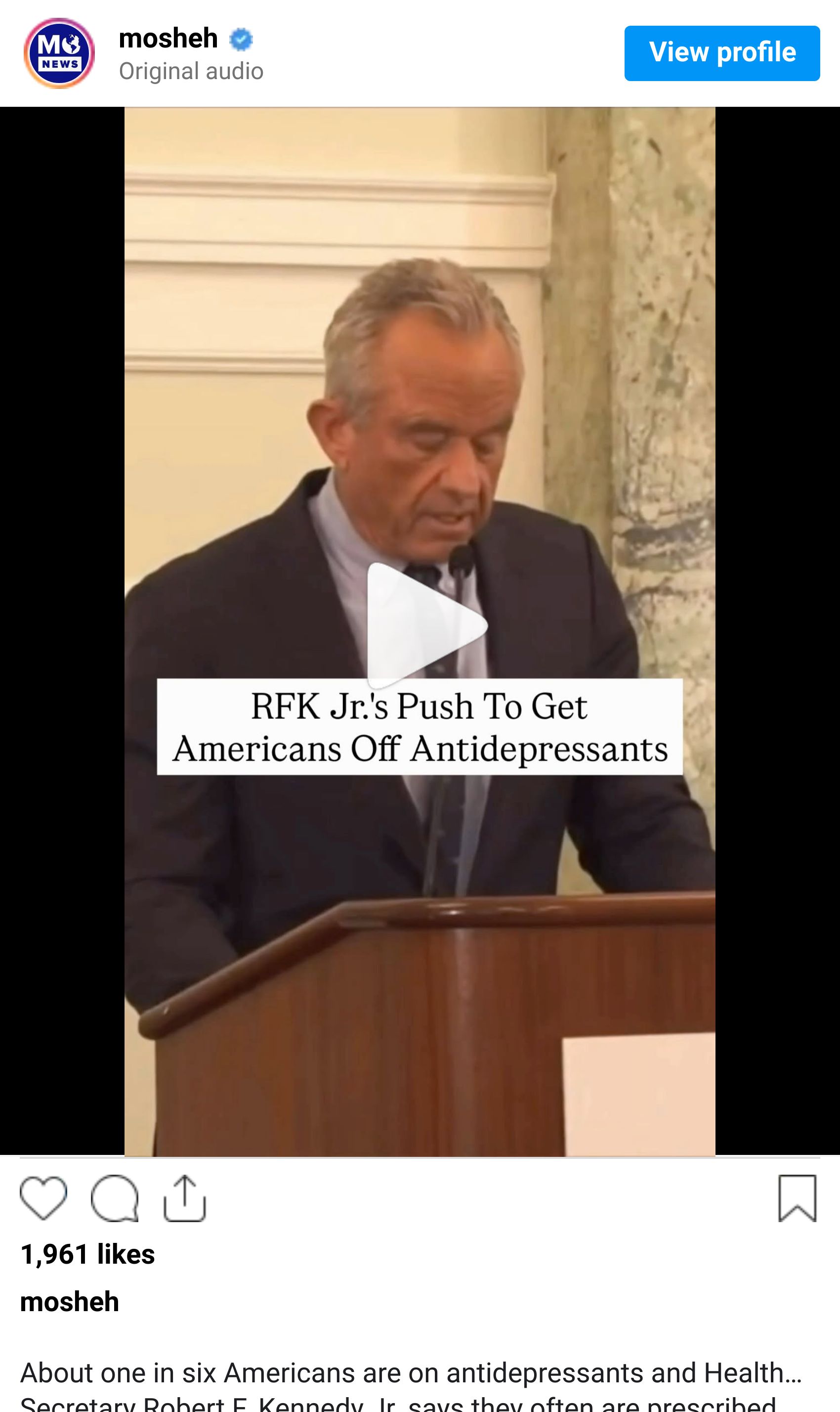
If you follow health news, you have probably seen recent comments from HHS Secretary Robert F. Kennedy Jr. about antidepressants, specifically SSRIs. Depending on where you saw it, you may have come across suggestions that these medications are overused, linked to violence, or that the mental health establishment has been misleading the public.
Kennedy announced a federal plan to wean Americans off antidepressants like Prozac and Zoloft, including new training, clinical guidance, and changes to insurance billing
I want to be upfront: this newsletter is not going to validate claims that are not supported by evidence. But I do think it is worth helping families understand what is actually being said, why clinicians are pushing back, and what matters most when it comes to mental health treatment for kids and parents alike.
What Is Being Claimed, and What the Evidence Actually Says
Kennedy has suggested that SSRIs are overused, linked to violence, and that psychiatric care has misled the public. The American Psychiatric Association and other major mental health organizations have responded clearly: the research does not support these claims.
SSRIs are among the most studied medications in modern medicine. For moderate to severe depression and anxiety, particularly in adolescents, the evidence for their effectiveness is robust. Like all medications, they carry risks that need to be weighed carefully. That weighing is exactly what a thoughtful clinician does with a patient and their family.
The link between SSRIs and violence has been examined and does not hold up as a causal relationship. People with untreated severe depression are far more likely to harm themselves than others. Treating mental illness with evidence-based medication does not increase risk of violence. That framing contradicts what the research actually shows. Kennedy has also previously claimed- without evidence- that these medications cause mass shootings.
To be fair, some elements of the plan are reasonable. Child psychiatrist Dr. Vera Feuer of the Child Mind Institute notes that careful assessment, supervised tapering, and expanding access to talk therapy are things good clinicians already support. And honestly — I agree that we can move too quickly to prescribe. But that is not the same as saying these medications are harmful, don't work, or are reckless.
For many people, SSRIs are a bridge, something that stabilizes you enough to actually do the deeper work in therapy. The problem is that bridge is sometimes the only thing people can access. The sad reality of mental health care in this country is that it is hard to get to not just financially, but logistically. The very people who are struggling the most often don't have the bandwidth to consistently show up to therapy, navigate insurance, sit on waitlists, or go through the exhausting process of finding a provider who is actually the right fit for them. The irony of pushing people off medication while therapy remains this inaccessible is something that cannot be glossed over.
A conversation about careful, individualized prescribing is worth having, and good providers are already having it. What concerns clinicians is something different: the suggestion that the answer is to reduce access to medications that keep people stable, functioning, and alive.
What I Want You to Hold Onto
If your child is on an SSRI, or a provider has recommended one, and you found yourself reading those headlines and feeling unsure, that makes complete sense. Here is what matters:
Medication is one tool, not the whole picture. SSRIs work best alongside therapy and support. A good provider is not prescribing without that conversation. If yours is not having it with you, that is worth raising.
The risk of not treating is real. Any conversation about medication risk has to include what happens when depression and anxiety go unaddressed. For moderate to severe presentations, that risk is serious.
Your provider's recommendation matters more than a news cycle. If you have concerns about your child's treatment, talk to your pediatrician or prescribing clinician. Ask about alternatives, goals, and timelines. That conversation is exactly where these decisions belong.
This Is Not Only a Conversation About Kids
I want to say something that does not always make it into these discussions: parents need mental health care too. And for some parents, that care includes medication. I know this not just as a clinician. I know it as a patient.
Nine months postpartum with my son, I was put on an SSRI for depression. I took it for six months and weaned off. When my daughter was born and postpartum anxiety hit, I started it again and wow, it helped. As I got more consistent with therapy, I weaned off again. But then I noticed something interesting. Every summer in Florida, I would become irritable, sometimes sad. It turns out I have reverse SAD. Seasonal Affective Disorder is most commonly associated with dark winter months, but for some people it is triggered by heat and excessive light instead. That was me. So I got back on an SSRI. And at some point I made the decision, with my clinician, to stay on it year round rather than cycling on and off. Combined with therapy, I am the most grounded I have ever been.
Maybe one day I will come off it. But that will be a decision I make with my provider. Not because of stigma, and certainly not because RFK Jr. is coming after it.
I know what it is like to be a healthcare provider, a parent, and a person who needed more support than willpower and a good routine could provide. That is part of why I feel so strongly about this.
Parental mental health is child health. When a parent is struggling, whether from postpartum depression, anxiety, chronic stress, or a condition that long predates having kids, the whole family feels it. Not because of anything that parent is doing wrong, but because families are connected systems.
So when messaging goes out suggesting SSRIs are dangerous or tied to harm, it does not only reach parents weighing options for their teenager. It reaches the parent who just started a medication after months of struggling. The one who finally asked for help after years of white-knuckling through anxiety. The one who is only functional right now because they found something that works.
If you are a parent on an SSRI or another psychiatric medication: that is a healthcare decision you made with a provider. It is not something to second-guess because of a news cycle. Taking care of your mental health is one of the most important things you can do for your kids, and you deserve support grounded in evidence, not fear.
Final Thoughts
But it is worth asking why so many people are struggling in the first place. Depression and anxiety are not just brain chemistry gone wrong. They are also a response to how we are living.
The cost of living has never been higher while wages have not kept pace. People are working more and resting less, often in jobs that offer no flexibility, no security, and no sense of meaning. Affordable housing is out of reach for entire generations. Childcare costs as much as a mortgage. Parental leave, where it exists at all, is laughably short. The village that used to raise children has been replaced by the expectation that one or two people do everything, alone, while also holding down a career.
Social media has fundamentally rewired how we relate to ourselves and each other. We are consuming comparison at scale, performing our lives for an audience, and mistaking scrolling for connection. For adolescents especially, the research on social media and mental health is not ambiguous. But adults are not immune either.
We are less connected to neighbors, to community, to religious or civic structures that used to provide belonging. We are sleeping less, moving less, spending less time in nature, and eating in ways that do not support brain health. Loneliness has been declared a public health epidemic.
And underneath all of it is a system that treats healthcare as a commodity, mental health as a luxury, and rest as a productivity problem. Capitalism is not designed around human flourishing. It is designed around output. And when people break down under that pressure, we hand them a diagnosis and debate the medication rather than examining what broke them.
So yes, brain chemistry matters. Genetics matter. But so does everything above. We cannot vilify a medication while doing nothing about the conditions making people sick in the first place. We cannot pull people off a drug without funding the therapy, the community support, and the affordable care that would need to replace it.
If you are navigating mental health concerns for your child or yourself, please talk to your provider. And if you are not sure where to start, that conversation can always begin with your pediatrician.
If you enjoyed this newsletter, I’d love for you to share it with others! Screenshot, share, and tag me @pedsdoctalk so more parents can join the community and get in on the amazing conversations we're having here. Thank you for helping spread the word!
Ask Dr. Mona
An opportunity for YOU to ask Dr. Mona your parenting questions!
Dr. Mona will answer these questions in a future Sunday Morning Q&A email. Chances are if you have a parenting concern or question, another parent can relate. So let's figure this out together!

