
This week inside:
What kids actually understand about Pride and identity at each age
Simple, ready-to-use scripts for common questions
How to answer without making it bigger than your child was asking
What to do when you freeze or fumble the first response
When a conversation might signal your child needs more support
Your child may point to a rainbow flag this month and ask what it means.
They may notice a Pride display, ask why a friend has two moms, or repeat a word they heard at school without fully understanding it. And suddenly, even though you believe in being kind and inclusive, you may find yourself wondering how much to say, what words to use, and how to answer without making it a bigger conversation than your child was actually asking for.
That is usually where parents get stuck.
We want our kids to grow up respecting people and understanding that families can look different. We also want to be developmentally appropriate, especially when questions about identity, gender, or sexuality come up earlier than we expected.
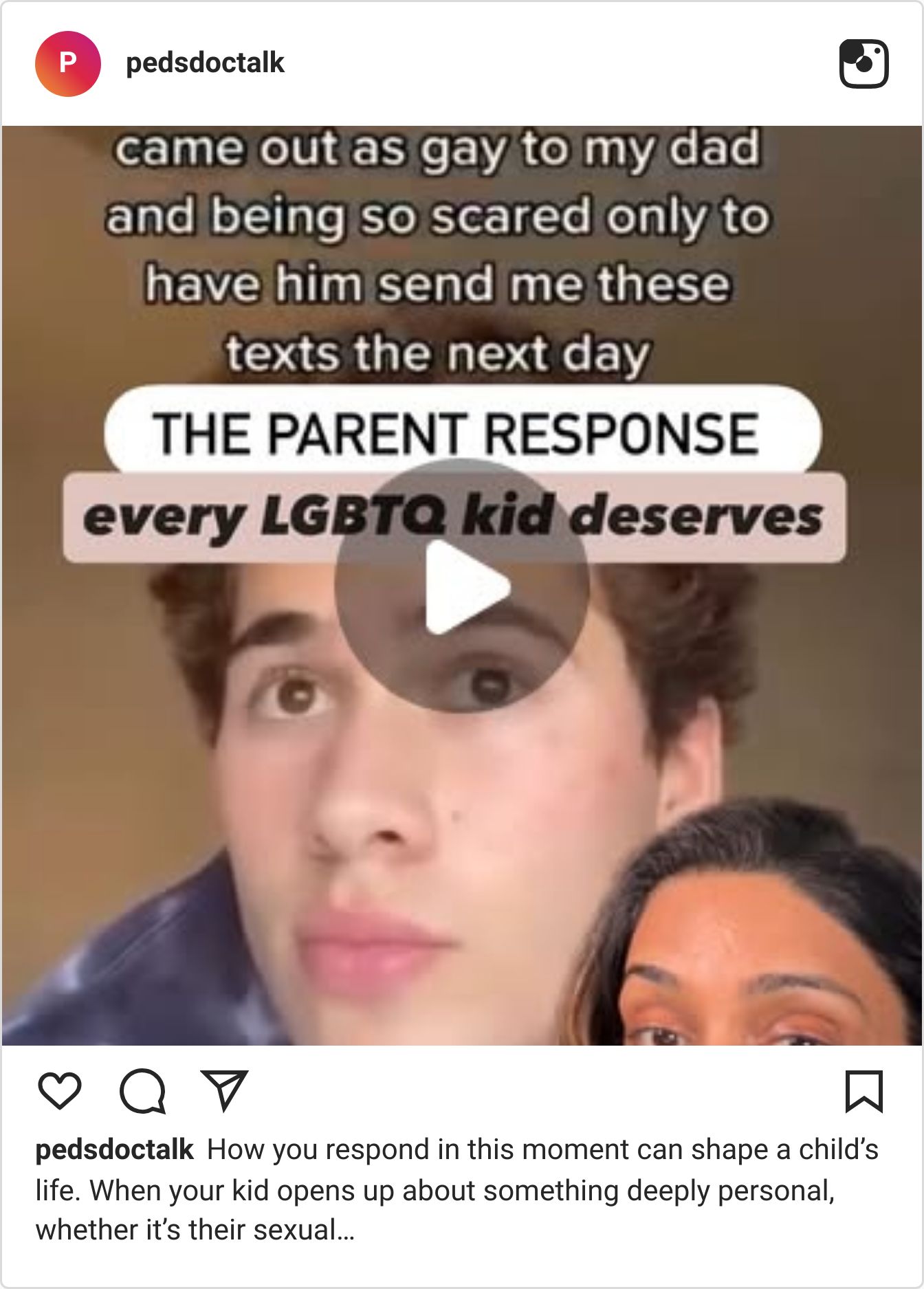
In that reel, I talk about something I believe deeply: when a child opens up about something personal, the way we respond matters. That could be about sexual orientation, gender identity, or something else they are still carrying quietly. A simple sentence like, “Thank you for telling me. I love you, and I want to understand,” can become something a child remembers for the rest of their life.
So I wanted to take that conversation further here, especially because Pride Month often brings up questions for kids and uncertainty for parents. What do kids actually understand at different ages? How much should we say? What if they ask a follow-up question and we freeze?
This conversation belongs in every family. Your child may be LGBTQ+. Someone they love, learn beside, or grow up with may be. And long before kids understand every word, they are absorbing our tone and learning whether home is a safe place to ask questions.
Why these conversations matter
Sometimes parents worry that talking about Pride or LGBTQ+ identities will introduce something too mature before a child is ready. I understand that concern, but for young kids, this conversation is usually much simpler than adults imagine.
It's often about families, names, kindness, fairness, and how we treat people who may be different from us.
A toddler does not need a detailed explanation of sexuality. They may simply need to hear, “Some families have a mom and a dad. Some families have two moms or two dads. Families can look different, and love is what makes a family.”
As kids get older, the conversation grows with them. They begin to understand privacy, bullying, identity, attraction, and what it means to be a safe person for someone else. This becomes part of family life in small moments, not one big perfect talk.
I also think it's important to name that most of us were raised with messages about gender, sexuality, families, and what was considered “normal.” Some of those messages were spoken out loud. Others were absorbed through silence, jokes, culture, religion, media, or family expectations. Growing up in a traditional Indian American household, LGBTQ issues were never discussed. I still remember when California was voting on same-sex marriage, my mother asked why I cared so much. "Are you A gay?" Yes, A gay. Anyway, I explained I wasn't, and that everyone deserves the right to marry who they want.
The saying goes, if you're not the pride flag, be the pole. Be the pole that holds up and supports those who identify as LGBTQ.
In college, I was a Resident Assistant, and I was that RA who always had my door open so residents could come and chat. I was in the freshman dorms, and multiple students came out to me, with me being the first person they had ever told. That trust, that honor of someone confiding something so personal, knowing I would accept them, that feeling never goes away. And it's how I wish parents would raise their kids, and how we're raising ours.
You can't force your child to be gay, just like you can't force them to be straight. What you can do is be a safe place for them to come to.
So if your child asks a question and you feel uncomfortable, it may simply be a cue to pause and notice what is coming up for you.
You can always take a breath and say:
That is a good question. I want to answer it well, so let me think for a second.
That gives you a little room without making your child feel like they did something wrong by asking.
And this is why I also see it as a health conversation. LGBTQ+ youth have higher rates of depression, anxiety, self-harm, and suicide risk, and research continues to show that family acceptance and supportive environments can be protective. Children need to know that love at home is steady, especially if they are carrying something tender or still figuring out who they are.
What toddlers and preschoolers can understand
Toddlers and preschoolers are concrete thinkers. They understand people, families, love, names, and simple rules. They also notice differences before they have the social filter to talk about them gently, which is why a child may say something loudly in public that makes you want to disappear into the cereal aisle.
At this age, keep it simple and calm.
If they see a rainbow flag and ask about it, you can say:
Pride is a time when people celebrate being themselves and being treated kindly.
If they notice a family with two moms or two dads, you can say:
Some kids have two moms. Some kids have two dads. Some kids have one parent. Families can look different.
It’s really THAT simple. Our own biases and judgment cloud these conversations.
Preschoolers may also ask very direct questions. “Can boys marry boys?” “Can girls marry girls?” “Why does that person look like a boy but have long hair?”
Try to answer the question they asked without racing ahead.
Yes, two men can love each other and get married.
Yes, two women can love each other and get married too.
People can wear their hair in different ways. Long hair is not only for girls.
And if your child says, “That is weird,” try to hear it as curiosity before you hear it as judgment. Young kids often use “weird” to mean unfamiliar. You can respond with:
It may be new to you. Different does not mean bad.
Then move on. At this age, the tone of your response often teaches as much as the words.
What early elementary kids can understand
Early elementary kids can understand more about fairness, exclusion, and privacy. They are also more likely to hear words from classmates, older siblings, YouTube, or school and bring them home without much context.
At this age, you can give a little more meaning behind Pride:
Pride Month is a time to celebrate LGBTQ+ people and remember that many people had to work hard to be treated fairly and safely.
If your child asks what LGBTQ+ means, you can keep it broad:
LGBTQ+ is a word that includes people who may be lesbian, gay, bisexual, transgender, queer, or still figuring out what words fit them.
You do not have to unpack every term in one sitting. If they ask what gay means, answer that. If they ask what transgender means, answer that. A lot of kids will take in the sentence, nod, and then ask what is for snack. That is okay.
This is also a good age to talk about privacy. If your child says, “My friend told me they are gay,” you can respond with warmth while also teaching an important boundary:
I am glad your friend trusted you. That may be personal, so we do not share it with other people unless your friend says it's okay.
That is a big lesson for kids. Being supportive also means understanding that someone else’s story belongs to them.
What tweens can understand
By the tween years, kids are hearing a lot from friends, school, online spaces, and social media. Some of it may be thoughtful, confusing, or mean. This is also the age when many kids begin thinking more deeply about identity, attraction, belonging, and how they are perceived by others.
This is an age where I want you to stay especially approachable.
If your child is asking broader questions about identity, relationships, bodies, or sexuality, you can keep the door open with:
You can always ask me questions about this. If I do not know the answer, I will find a good one.
If your child asks whether they might be gay, bisexual, transgender, or something else, try to stay steady. You do not have to figure everything out for them in that moment.
You do not have to know everything about yourself right now. Some people know early, and some people understand themselves over time. I love you, and I am here with you.
This is also an important age to talk more directly about jokes and bullying. A lot of kids hear words like “gay” used as an insult before they fully understand what the word means. They may also hear comments about someone’s voice, clothes, interests, body, or who they spend time with.
If your child hears those comments or sees someone being targeted, you can say:
If people are making fun of someone for being gay, trans, or different, that can really hurt. In our family, we do not join in with that. You can change the subject, check on the person later, or get an adult if someone is being targeted.
I want kids to understand that kindness has a backbone. It's not only about being nice when everyone is watching. Sometimes it means not laughing at the joke, changing the subject when a conversation turns cruel, checking on someone later, or knowing when to bring in a trusted adult.
When the conversation goes deeper
Sometimes the first question is easy enough to answer, and the follow-up is where parents freeze.
A child asks, “What does gay mean?” You answer. Then they ask, “How do people know?” or “Can I be that?” or “Why were people mean to them?” Suddenly, the conversation feels bigger than you expected. Remember, you can slow down.
I am glad you asked. Let me think about how to explain that in a way that makes sense.
I do not know the best answer yet, but I will learn and come back to it.
If you say you are going to come back to it, make sure you do. That shows your child their question mattered, and it also shows them that grown-ups are allowed to keep learning too.
This matters even more if your child is asking because they are trying to understand something about themselves. You may not know that in the moment, which is why I want the first response to feel steady.
If your child says something like, “I think I might be gay,” or “I do not know if I feel like a boy or a girl,” start with connection.
Thank you for telling me. I love you. I am really glad you came to me.
Then you can gently ask what would feel supportive right now, or whether they want to talk more today. Some children will want a longer conversation. Some will share one sentence and then need space.
And if your child is struggling with depression, anxiety, self-harm, bullying, or intense distress, please bring in support. Talk with your pediatrician, a licensed mental health professional, or a clinician experienced in supporting LGBTQ+ youth.
If you stumble, you can still repair. Go back and say:
I have been thinking about what you asked me earlier. I do not think I answered the way I wanted to.
I seemed uncomfortable, and I do not want you to think that means you did something wrong.
That kind of repair is important because it teaches our kids that hard conversations can keep going, and that we are willing to keep growing with them.
Final thoughts
As Pride Month comes to a close, the rainbow flags and posts may become less visible, but the messages our kids receive about families, identity, respect, and safety continue all year.
Our kids notice how we talk about families that look different from ours. They notice how we respond when someone shares something personal, when a relative makes a comment, or when a joke crosses a line. Over time, those small moments shape whether a child believes they can bring us their questions, their confusion, or one day, something deeply personal about who they are.
I want to say this again because I think everyone needs to hear it: you do not have to know every term or get every sentence exactly right. You can keep learning, repairing, and showing your child that curiosity is welcome in your home.
And if one day they come to you with something they have been carrying quietly, you can come back to the sentence we started with:
Thank you for telling me. I love you, and I am so glad you came to me.
If you enjoyed this newsletter, I’d love for you to share it with others! Screenshot, share, and tag me @pedsdoctalk so more parents can join the community and get in on the amazing conversations we're having here. Thank you for helping spread the word!
On YouTube
As a pediatrician and mom, I’m here to de-influence you from 11 of the most popular yet unnecessary baby products on the market. From weighted sleep sacks and wearable vital sign monitors to baby walkers, many heavily marketed registry items sell emotional relief to parents rather than real medical benefits. In this video, I break down the science, safety risks, and developmental facts behind these trending baby items to help you save money, reduce anxiety, and trust your baby’s natural growth.
Ask Dr. Mona
An opportunity for YOU to ask Dr. Mona your parenting questions!
Dr. Mona will answer these questions in a future Sunday Morning Q&A email. Chances are if you have a parenting concern or question, another parent can relate. So let's figure this out together!

