
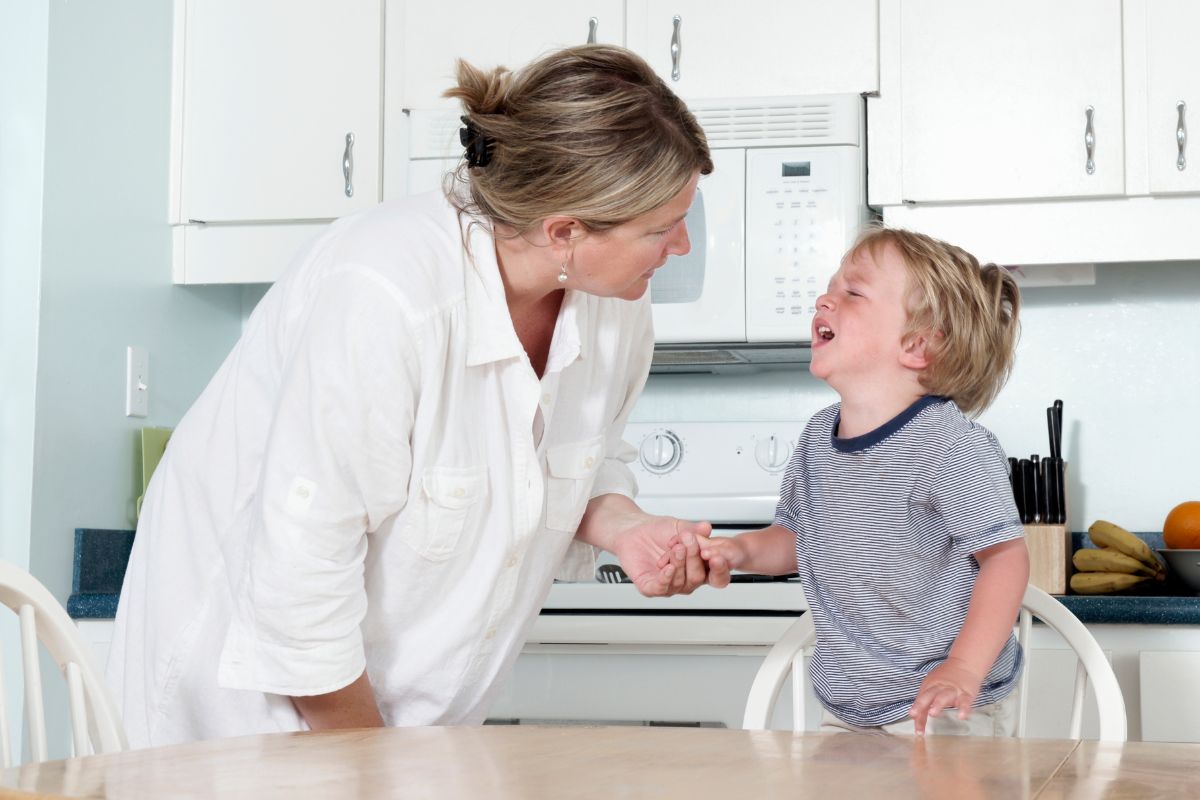
“My almost 3 year old boy (35 months) has become really mean. He used to talk to everyone, including strangers, and especially when we would walk out of a plane, for example, saying hi and smiling as we went. He now says things like, "Go away", "You have poop in your butt", "You're poop"... I'm embarrassed to keep going. He says this not only to his parents, but grandparents and other family members, strangers, kids, etc. No one is off limits. This has been going on for almost a year now. We initially tried to ignore it because I know that giving it attention will cause him to do it more, but we just couldn't help ourselves in disciplining him when he would say it to family members and strangers. Now I think that we've given it so much attention that it became a habit and he can't stop. What can we do?? I have met the kids in his daycare class and friends' kids and I have never heard any other two year olds talk like this. He is also still hitting, pinching and pulling hair, which he has been doing since he was 1. Similar issue here where we tried to ignore him but there were circumstances so bad that we felt we needed to discipline him. I'm at a loss. How can we get him back to being a sweet little boy?”
The little boy who waved to each passenger getting off the plane is still there. The difference is that by the age of two he has worked out that a number of particular words cause adults to gasp, freeze, or rush about. For a toddler, that is a very fun thing to do.
And the words he chooses are about as classic as it gets. During the period of potty training and in the preschool years, bathroom talk is quite common, especially since the vocabulary helps children understand their bodies and partly because it has a strong shock value, as the American Academy of Pediatrics puts it. The level of aggression also matches his age; large long-term studies have shown that physical aggression reaches its peak somewhere between the end of age two and the end of age four. So most of what you’re seeing is typical toddler behavior that just keeps repeating itself.
Let’s also talk about the phrase “go away.” Between the ages of two and three many children become selective about the people they interact with. The little boy who used to greet everybody may now be more cautious, and the only way he knows how to express this is by saying “go away.” This could be his most awkward way of meaning that he doesn’t want to talk to you at the moment. It is a genuine feeling, and all he needs is a more pleasant way of expressing it.
Regarding ignoring: you didn’t do anything wrong by responding. Ignoring only succeeds when the reaction vanishes entirely, and no family on this planet could keep a serious (or calm) face for an entire year while a toddler tells Grams that she has poop in her butt. The thing that helps at that moment is making the response so brief and dull that the words cease to have any impact:
Give them a flat response and then move on. Keep your expression neutral and say something like “potty words are for the bathroom.” Or, if you want to be even more boring, “Does it sound as if you might need to go potty?” Offering casually to use the bathroom is a dull reply and at the same time lets children remember what those words are really for. There’s no need for a lecture, no need to look serious and no need to repeat the word back to him.
Give him a more suitable tool for expressing his feelings. If he says, “go away,” then say “You don’t want to talk at the moment. You can say, ‘No thank you.’” What you’re doing is replacing the words without changing the need underlying them.
Get everyone else to use the same script. If one person laughs but another becomes annoyed, he’ll carry on testing to see which reaction he gets. In the case of strangers, just tell them quickly that “he’s learning kind words,” and that’s that.
Give him a space where it’s okay to use silly language. Bath time can serve as official silly-word time. Toddlers can begin to learn that some kinds of talk are appropriate in some situations and not in others, and having a “yes” response removes some of the excitement associated with forbidden behavior. Then pick out a moment when he is being kind by saying, “You said hello to Grandpa. That made him so happy.” Since he is clearly looking for a big reaction, give him a large one for the things you value most.
Hitting, pinching, and pulling someone’s hair are different since they involve safety and therefore cannot be ignored. You should block his hand, move his body or the person he is hitting, and keep it simple by saying “I won’t let you hit.” Then provide him with something else to do instead, such as having him stomp or squeeze a pillow. This blog post explains how to respond to hitting and throwing at each age, and this YouTube video does the same.
As for the other children in his class, children tend to display their most difficult behavior towards the people they feel most at ease with, and other parents generally don’t share what their children say at home. I can promise you that you aren’t the only family at that daycare hearing potty talk at home.
The good news is that, as they get older, most children become better at controlling physical aggression. That said, as this situation has continued for some time, it also may be worth mentioning to his pediatrician if the hitting occurs most days, if daycare is also seeing it, if his speech appears to be behind (since frustration over not being able to express himself can lead to hitting), or if no improvement is seen after a few weeks of consistent efforts.
Once these words stop getting a rise out of everyone, that friendly little guy has a lot more room to show up again.
For more on this, I answered a similar question about potty language in a past newsletter, and this PedsDocTalk podcast episode talks through hitting, throwing, and why even a negative reaction can feel like a win to a toddler. And for the everyday toddler stuff, the PedsDocTalk Toddlers & Tantrums Course has scripts and real-life scenarios for exactly this kind of moment.

“My 2.5 year old daughter is an incredibly sweet and friendly child. But around other kids, she almost always defaults to backing down or giving in and is really reluctant to assert herself. How can I help her stand up for herself a little more and build her self-confidence without making her feel like there's something wrong with being friendly and empathetic?”
A sweet and friendly child is ideal to start with since she doesn’t have to give any of that up in order to learn how to hold onto her shovel.
At 2.5, the ability to speak up for yourself is entirely new. Most children at that age are still getting used to the words they want, never mind managing to say them quickly when another toddler is pulling a toy out of their hands. Temperament also has an influence here: around 15% of children naturally tend to stay back when faced with new situations. Children who are cautious also tend to be keen observers and to think things through before taking any action.
Something worth noting is how she appears after she has given in; if she happily gives up the toy and then goes off to do something else, this might simply be a sign of flexibility. But if she looks sad, comes to you in a distressed mood, or continues to stare at the toy she has lost, then it’s clear that she wants to keep it but doesn’t yet have the necessary skills.
A few ways to help:
Give her small words that she can quickly use. “Stop,” “I’m using it,” and “It’s still my turn.”
Practice at home with you. Have a stuffie try to grab her toy and have her tell it “I’m using it.” Kids learn these skills much faster in play than in the heat of the moment.
Let her “no” matter at home. When she says stop during tickles, stop immediately. Let her make choices about what snack she wants or what shirt she wants to wear. Every time her voice gets to pick, she learns that her voice is worth using.
Don’t step in for her. After one of these moments, say, “Did you want to tell him something? You can say ‘I’m using it.’” If she freezes, say it with her.
Point out when kindness and speaking up show up together. “You let her have a turn, and you told her when you wanted it back. That was so kind of both of you.” This shows her that being nice and being heard can happen at the exact same time.
It’s best to avoid using labels such as “shy” or “a pushover” when talking to her. I talk about this more on this PedsDocTalk podcast episode.
The goal is a kid who can be kind to others and still speak up. Now it may mean saying no at the playground, and by the time she is 13, it will involve refusing to take part in something a friend is pushing her into that doesn’t feel right. The words she is practicing at the moment are the ones she will use then, too.
If you want more role-play ideas and ways to build social confidence, this past PedsDocTalk newsletter on building confidence in preschool has more scripts to try.
PDT Real Talk Series
This month’s question is:
"What is your kid scared of right now, and what has actually helped?"
October has a way of bringing fears out of hiding. Suddenly the neighbor's inflatable skeleton is a problem, the dark hallway feels a mile long, and a costume that was "so cool" at the store becomes terrifying the second it goes on. If your kid is suddenly scared of things that never bothered them before, that's a normal part of growing up. Little kids have big imaginations but are still learning what's real and what's pretend, which is why fears of monsters, the dark, and masks are so common in the preschool and early school years.
So tell me what's going on at your house. Maybe it's the vacuum, maybe it's thunder, maybe it's a very specific cartoon villain. And more importantly, what has helped? A flashlight by the bed, a "monster spray," a pep talk, or just sitting with them until the scary feeling passed? Nothing is too small or too silly to share.
Please share your response using the link below. Submit by October 21st and selected responses may be featured in the October Real Talk newsletter.
Ask Dr. Mona
Ask Dr. Mona all your parenting questions!
Dr. Mona will answer these questions in a future Sunday Morning Q&A email. Chances are if you have a parenting concern or question, another parent can relate. So let's figure this out together!

